Riot Grrrl's Grandkids: Meet the Teenagers Printing Their Way to a Publishing Revolution
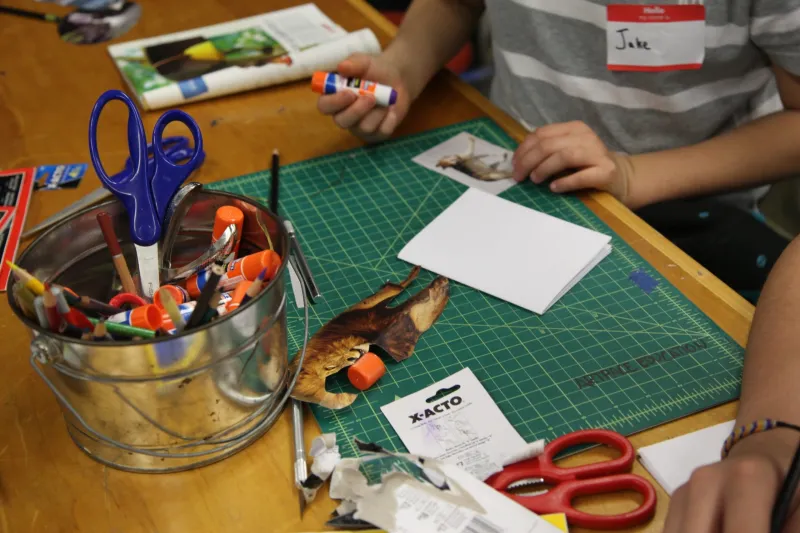
Photo: teenagers making zines photocopier craft table, via artpace.org
The copy machine at the Multnomah County Library in Portland has a problem. Every Thursday afternoon, a cluster of teenagers crowds around it, feeding in pages of hand-drawn comics, poems about climate anxiety, and manifestos about school dress codes, cranking out dozens of folded, stapled zines that vanish within days.
They're not doing it for class credit. Nobody's grading them. They're doing it because, as sixteen-year-old founder Marisol Vega puts it, "the internet is where everyone talks and nobody listens. Paper is where you actually have to mean it."
Print as Protest, Again
If the phrase "teens making zines" gives you déjà vu, it should. The Riot Grrrl movement of the early '90s was built on photocopied pages passed hand to hand. But today's teen zine makers aren't just reviving a format — they're running full operations. We're talking mastheads, submission guidelines, print runs of 200, and Instagram accounts that function as distribution networks.
In Atlanta, a collective called Souvenir Paper operates out of a member's garage, publishing a quarterly lit mag featuring writers from twelve different high schools. In Detroit, teens at the InsideOut Literary Arts program have launched a risograph co-op, printing posters and poetry chapbooks for community groups at cost. And in a Chicago suburb, a seventeen-year-old named Dae-ho Park runs a zine distro — yes, a distro — that carries titles from forty young makers across the country, trading inventory through the mail like it's 1994.
What unites them is a shared conviction that print is countercultural now. "Our whole lives are screens," Park told me. "A physical thing you can hold, trade, hide in your backpack — that's the rebellion part."
The Adults in the Room (Quietly)
Here's where the story gets interesting for anyone who cares about the future of independent publishing: established small presses are paying attention, and some are quietly building mentorship pipelines.
Feminist press Solidarity Texts in Philadelphia runs a summer apprenticeship that hands teens a real budget and a real ISBN. A micro-press in Minneapolis lets its youth editorial board pick one title a year for actual publication. These arrangements are rarely publicized — partly because of liability paperwork, partly because the presses don't want to look like they're farming free labor.
"We're not trying to extract anything from these kids," says one publisher who asked to remain anonymous. "We're trying to make sure someone's running a small press in 2045. Because right now, the pipeline into this work basically starts at age twenty-eight with an MFA debt load. That's not sustainable."
Will It Stick?
Skeptics will point out that teen zines have flared and faded before, and plenty of these collectives will dissolve when their founders graduate. But three things look different this time. First, the infrastructure exists: cheap print-on-demand, risograph access at libraries, and Etsy-style storefronts mean a sixteen-year-old can operate like a micro-press, not just a photocopier hobbyist. Second, the skills transfer — the teens running these projects are learning budgeting, editing, distribution, and community-building in exactly the way the indie publishing world has been desperately trying to teach adults.
Third, and maybe most important: they're having fun. Ask any burned-out small press founder what they miss, and they'll describe something that looks a lot like a garage full of teenagers arguing over a cover design.
The next generation of independent publishing might not come from journalism school or a Big Five exit. It might come stapled together on a Thursday afternoon in Portland, Atlanta, Detroit, and a dozen towns in between.
Small Press Month will be watching — and handing them the stapler.