The Four-Quote Reality Check: What 1,000 Copies of Your Book Really Runs in 2025
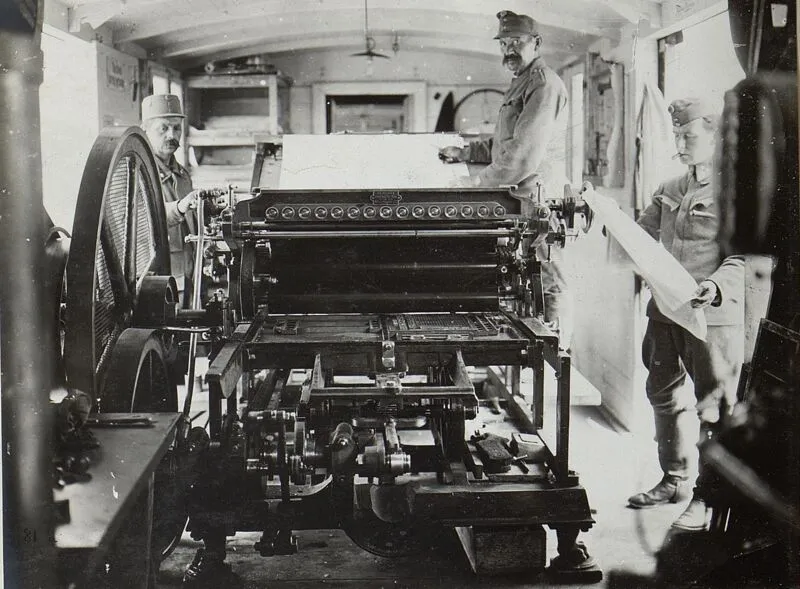
Photo: Unknown authorUnknown author, Public domain, via Wikimedia Commons
Somewhere right now, a first-time publisher is opening an email from a printer, seeing a number in the four-figure range, and having a small heart attack. This article is for them — and for the veterans who remember when that number was 30% smaller.
We asked five American printers to quote the same hypothetical job: a 250-page trade paperback, 5.5" x 8.5", 50# cream interior stock, a four-color cover, 1,000 copies. Here's what came back.
The Raw Numbers
Offset printing (where your book runs on a traditional press, cheapest per unit at volume) came in between $4,100 and $5,600 for the full run. The spread depends heavily on whether the printer is bidding the job alongside other work or scheduling it as a standalone. One Midwest printer told us flatly: "If your timing is flexible, tell us. A fill-in slot can save you a grand."
Digital printing (toner-based, ideal for short runs) quoted at roughly $4,800–$5,900 for 1,000 copies — sometimes more than offset at this quantity, which surprises people. Digital's advantage isn't price at 1,000 units; it's that you can print 100. At 1,000, you're often paying a premium for flexibility you don't need.
Hybrid routes — digital for a first run, offset for a reprint once demand is proven — quoted at about $2,600 for 300 digital copies, with an offset reprint of 1,000 coming in around $4,300 later. Total outlay is higher, but risk is dramatically lower.
The Costs Nobody Quotes You
That printer quote is not your cost. Add:
- Freight. 1,000 paperbacks weigh roughly 800–1,000 pounds. LTL freight from printer to warehouse runs $250–$600 depending on distance and fuel. Cross-country? Budget the high end.
- Paper volatility. Coated stock prices have swung double digits in recent years, and quotes are typically valid for 30 days. A delay in finalizing files can literally change your price.
- Tariffs and supply quirks. Some specialty papers and printing components carry import exposure, and printers are increasingly hedging with surcharge clauses. Read the fine print — one publisher we spoke to got hit with a 4% "materials adjustment" after signing.
- Storage. Where do 18 boxes of books live? If the answer is "your garage," congrats. If it's a fulfillment center, add monthly fees.
Regrets, We've Heard a Few
The most common regret we heard wasn't about price — it was about quantity. "We printed 1,500 because the per-unit math looked better," one press founder admitted. "We sold maybe 400 in a year and ate the storage costs for the rest." The per-unit savings on overprinting are real, but only if the books move.
The second regret: not asking about timeline. Offset runs typically take 3–6 weeks after proof approval. If your book has a review embargo or a seasonal hook, build in buffer time or pay rush fees.
The Bottom Line
For a standard 1,000-copy paperback run in 2025, budget $5,000–$7,000 all-in — printing, freight, and incidentals — and treat anything under $4,500 as a quote worth verifying line by line. Ask about fill-in scheduling, confirm quote validity periods, and never let a sales rep talk you into a quantity your distribution plan can't support.
The check is big. The surprise fees don't have to be.